Goal: Build a DAVE-class DAC for 1/25th the price. From zero FPGA
knowledge. In three months. Because how hard can it be?
The backstory starts in the 1980s. Music has been my lifeline for as long as I can remember. Headphones have been essential to how I work for as long as I can remember — the ONLY way I can concentrate and get things done is with music on my head. That's been true for 40 years.
The obsession with audio hardware predates this project by decades. In 2002 I was on the Rockbox mailing list — an open-source firmware project for the Archos Jukebox media player — debugging gapless playback, analyzing CBR vs VBR decoding artifacts, and asking about ID3 tag filtering before data hits the decoder chip. Hacking audio player firmware at the hardware level, 23 years before building my own DAC. The thread was always there.
Fast forward to Chord Mojo 1. When I first heard music through that thing, something shifted. Details I'd never perceived before: the squeaking of a piano bench. Someone coughing in the audience. The texture of bows being pulled across cello strings. It wasn't "music listening" anymore — it was "music perceiving." I remember sitting in a client's office, Chord Mojo, Sennheiser IE800, Audirvana feeding Olafur Arnalds in 96kHz. I could hear it all. And I loved it.
I tried other DACs. Bought an RME ADI-2 DAC in Japan alongside a Hifiman HE1000 Unveiled. Great reviews, great specs. Back home... I hated it. Flat. Boring. I tried every filter setting — linear phase, NOS, minimum phase — but I couldn't articulate WHY it was wrong. I just missed "falling into the depth of music." That feeling where reverb creates a three-dimensional space and you're INSIDE it.
Last resort: plugged in my Mojo 2. Magic was back instantly. Mojo 2 → Burson Soloist → Hifiman planars? Transcendent. That confirmed it wasn't placebo. Something about Rob Watts' approach — massive tap counts, noise shaping, transient precision — creates what I can only describe as "auditory OLED." Pitch black background. Razor sharp transients. High-contrast sound that makes music feel real.
So naturally: what's the best headphone? Hifiman Susvara. Bought it. Loved it. But then... what's next? If Watts figured out that more taps = more magic, then I need more taps. Hugo TT2? $5k. DAVE? $12k+. No. I don't pay $12k for a DAC. I'd rather build my own.
Because: I've been writing software since age 6. Over 40 years. And what's an FPGA? Software-defined hardware. "How hard can it be?"
Famous last words.
starting from zero
Starting from ZERO:
  - Never touched Verilog in my life
  - Never used an oscilloscope
  - Never designed a circuit
  - Never ordered a PCB
  - Never heard of sigma-delta modulation
  - Never implemented a FIR filter
Using AI as my teacher (Claude, specifically — learning the way I learn best: try, fail, ask questions, remember forever), I went into full hyperfocus mode and speedran the entire discipline.
10 weeks later: 507,904-tap polyphase FIR. Cascaded noise shaper. Multi-bit resistor array output. Custom 4-layer PCBs from China. Audio coming out of an FPGA that sounds like it has no business sounding this good. And now it's becoming a real product — the BELLA DAC 1, under Pretty Good DACs.
format · stack · signal chain
Format: FPGA audio DAC — digital signal processing in Verilog,
analog output stage on custom PCB, MATLAB for algorithm validation.

Stack:
  - Xilinx Nexys Video (XC7A200T Artix-7, $500)
  - Amanero Combo384 USB-to-I2S (all sample rates)
  - Verilog (89 files, 28,018 lines)
  - Vivado 2025.2 (synthesis + P&R on i9-14900K Gaming PC)
  - MATLAB (fixed-point SDM modeling, NTF analysis)
  - Python (coefficient generation, UART interface, captures)
  - KiCad (custom PCB design, currently v0.4.4 — 4-layer board)
  - OPA1612 opamp output stage (±12V, breadboard → custom PCB)

Signal chain:
  USB Audio → Amanero I2S → FPGA →
    256× Polyphase FIR (507,904 taps)
    → Cascaded noise shaper (33 levels)
    → Multi-bit resistor array (phase-shifted PWM)
    → Analog Reconstruction (custom PCB, OPA1612)
    → Headphone Amplifier → Susvara
SIGNAL PROCESSINGWhy It Sounds Different
507,904-Tap Polyphase FIR — Transient Reconstruction
Rob Watts' core insight: above 16× oversampling, you hear "massive changes in sound quality." Clarity, soundstage, the perception of notes starting and stopping precisely. This is about reconstructing transients — the sharp attacks and decays that make music feel REAL.
polyphase FIR · 507,904 taps
My implementation: 256× upsampling via polyphase FIR.
  - 124 filter tiles × 8 taps/tile × 256 phases = 253,952 taps (1× mode)
  - 2× mode via symmetric coefficients = 507,904 taps
  - 2 DSP48E1 blocks per tile (25×32-bit native multiply — no split)
  - ~75% of available DSP resources used — room to push further
  - Custom-designed sinc filter/window ("GOAT filter")
  - Multi-rate output: 256×, 128×, 64×, 32×, 16× selectable
  - Field-updatable coefficients via UART
For context: Chord DAVE uses ~164,000 taps. I'm at 507,904. Over 3× DAVE.
The coefficients are generated in Python, uploaded via 2 Mbaud UART, and stored in 112 parallel BRAM blocks. Each build takes ~20 minutes on the Gaming PC (i9-14900K). Coefficient uploads take seconds.
5th-Order CRFB Sigma-Delta Modulator
The FIR outputs clean, highly oversampled audio. But you can't feed that directly to a 1-bit or few-bit output — you need noise shaping to push quantization noise above the audible band.
sigma-delta modulator · CRFB
My SDM: 5th-order Cascade of Resonators, Feedback Form (CRFB).
  - 65 levels (-32 to +32 signed)
  - 1-stage DSP48 feedback pipeline (minimizes latency)
  - Noise shaped above ~100kHz (inaudible, filterable)
  - The 1-stage pipeline vs earlier 3-stage = 22dB improvement
    in noise at 100kHz. Feedback latency kills noise shapers.
The NTF coefficients are designed in MATLAB, validated against int64 golden models (~42k samples/sec), then translated to Verilog. I can now iterate SDM designs in MATLAB before touching any hardware.
This is where Chord's magic lives. And where I spent months debugging before understanding WHY.
The problem: converting a multi-level SDM output to analog. The naive approach (thermometer encoding — more "on" pins for higher values) has a fatal flaw: SIGNAL-DEPENDENT switching noise. The number of transitions per cycle depends on the signal, which modulates the noise floor. You can hear it as "graininess."
Rob Watts' solution: something he calls "pulse array." He's never published the exact implementation — it's his trade secret. But from his talks and papers, the key principle is clear: constant switching activity, independent of signal level. Whatever he's doing, the noise floor doesn't modulate with the signal. Clean.
My implementation: phase-shifted slotted PWM across differential elements. The phase offsets ensure that up-transitions and down-transitions overlap in time, cancelling switching noise at the summing node. The specifics of the output stage architecture are where a lot of my R&D focus is going — more to share once validated in hardware.
I learned this the hard way. Months of "why does thermometer encoding sound grainy?" until the theory clicked. Never suggest thermometer encoding to me. Ever.
Current PCB (v0.4.4): 2×4 elements with externally clocked D flip-flops and a dedicated 100 MHz crystal. Scaling to 2×20 elements once the DFF clocking is validated. The analog foundation has to be bulletproof before throwing more elements at it.
The CDC Discovery — Killing the 47kHz Horns
February 6, 2026. The day I understood clock domain crossings.
The FIR outputs samples in bursts (17.6µs of data, 3.2µs silence). This periodic burst pattern creates intermodulation products — ugly 47kHz/49kHz sidebands at -55dB. I called them "the horns."
The fix was embarrassingly elegant: rate-limit the CDC output to one sample every 16 clock cycles (constant rate, no bursts). Result: the horns dropped from -55dB to -232dB. A 117dB improvement from a one-line change.
The deeper insight: 128× upsampling at 48kHz gives an integer CDC ratio (2048/128 = 16 cycles). Integer = clean. My earlier 72× attempt had a ratio of 28.44 — fractional = periodic jitter = "batman ears" in the spectrum. The math has to be CLEAN.
Custom PCBs — Learning Hardware From Zero
The FPGA is 50% of the project. The other 50% is getting analog audio out of digital pulse trains. That means: opamps, resistor networks, power supplies, ground planes, impedance matching.
PCB · hardware iteration
Three months ago, I didn't know what KiCad was. Now I'm on PCB
revision v0.4.3 — a 4-layer custom board with:
  - Hardware flip-flops (signal integrity at FPGA output)
  - Dual OPA1612 opamp stage
  - Precision summing resistor network
  - Proper ground planes and power filtering
  - Designed for JLCPCB manufacturing
The breadboard prototype already hit -99dBc H2 (second harmonic distortion). That's a 34dB improvement over bare FPGA pins through a 22pF capacitor and some careful opamp configuration.
Every board revision ships from Shenzhen. I order, wait 2 weeks, solder, test, learn, iterate. It's the slowest feedback loop in the project — and the most satisfying when it works.
Oh, and I taught myself SMD soldering. Bought a rework station to fix a JLCPCB assembly mistake. Three months ago I didn't know which end of a soldering iron gets hot. Now I'm reflowing 0603 components with a hot air gun. The speedrun has no brakes.
SCREENSHOTSFrom Zero to DAC
The Hardware
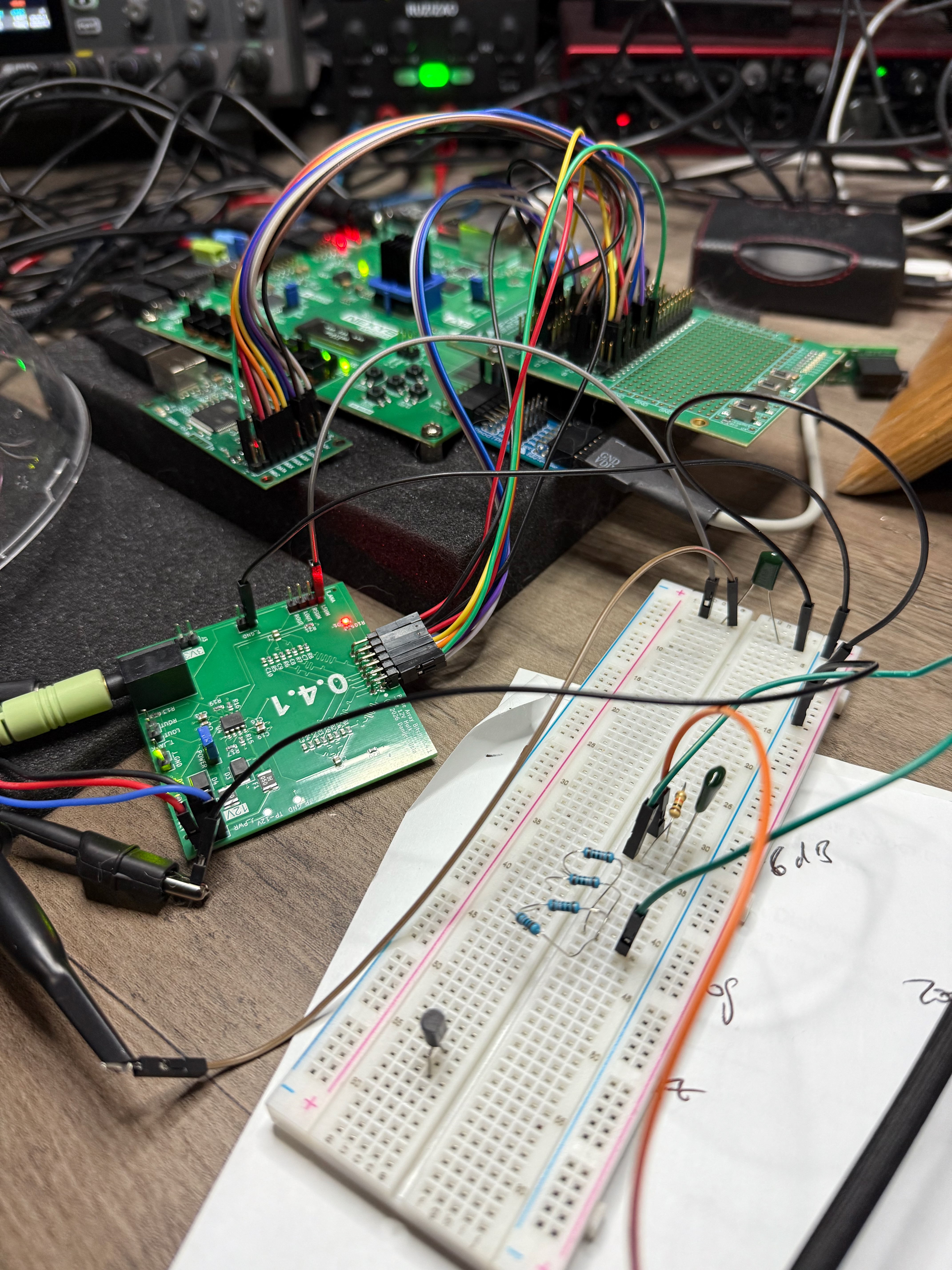
workbench-chaos.jpeg
What FPGA audio engineering actually looks like. Nexys Video board, custom PCB v0.4.1, breadboard analog stage, oscilloscope probes, handwritten notes. Three months ago none of this existed.
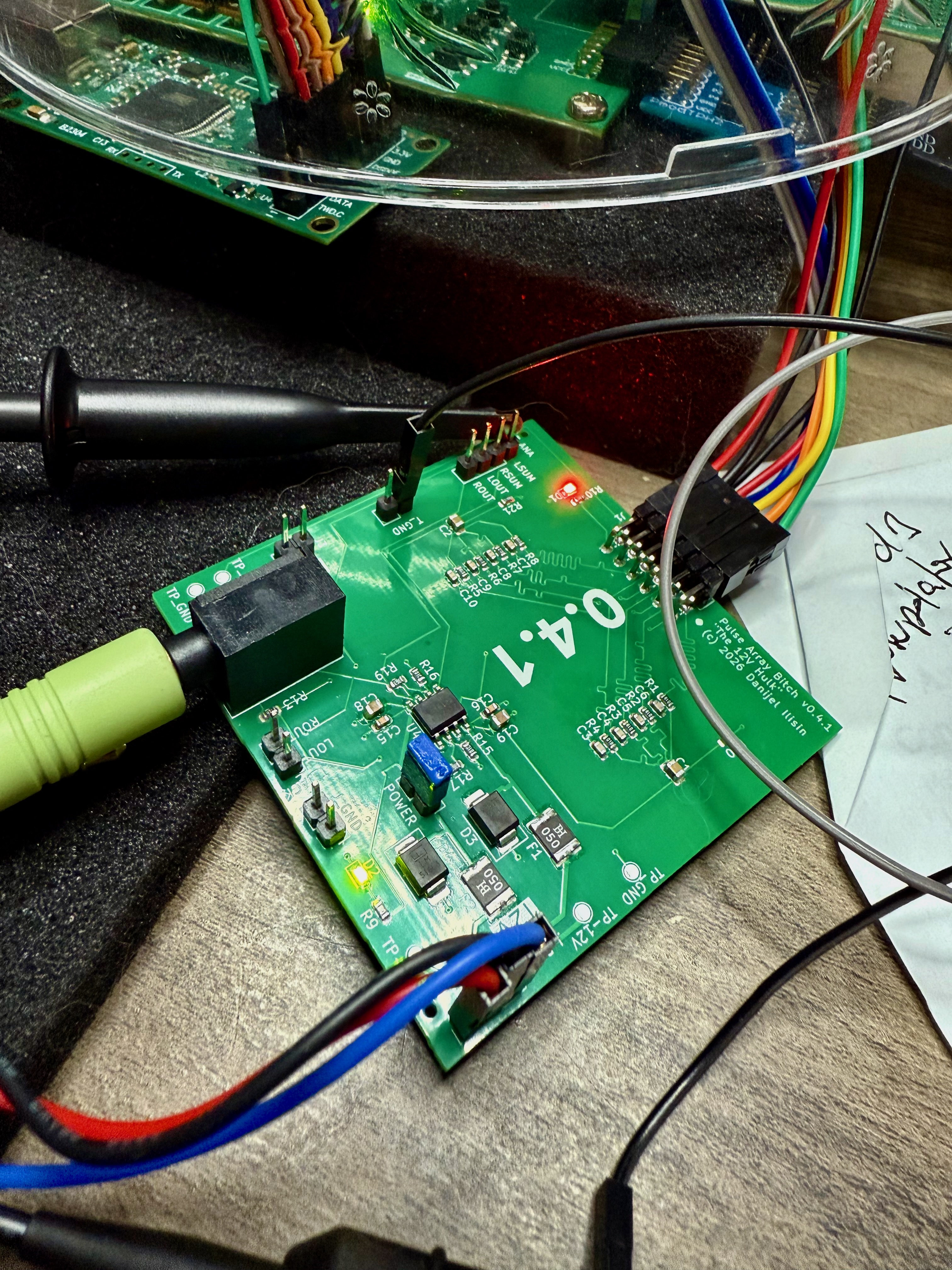
pcb-v041-closeup.jpeg
Custom PCB v0.4.1 — designed in KiCad, manufactured by JLCPCB, probed with a Siglent oscilloscope. That "0.4.1" silkscreen is three months of iteration compressed into a green rectangle.
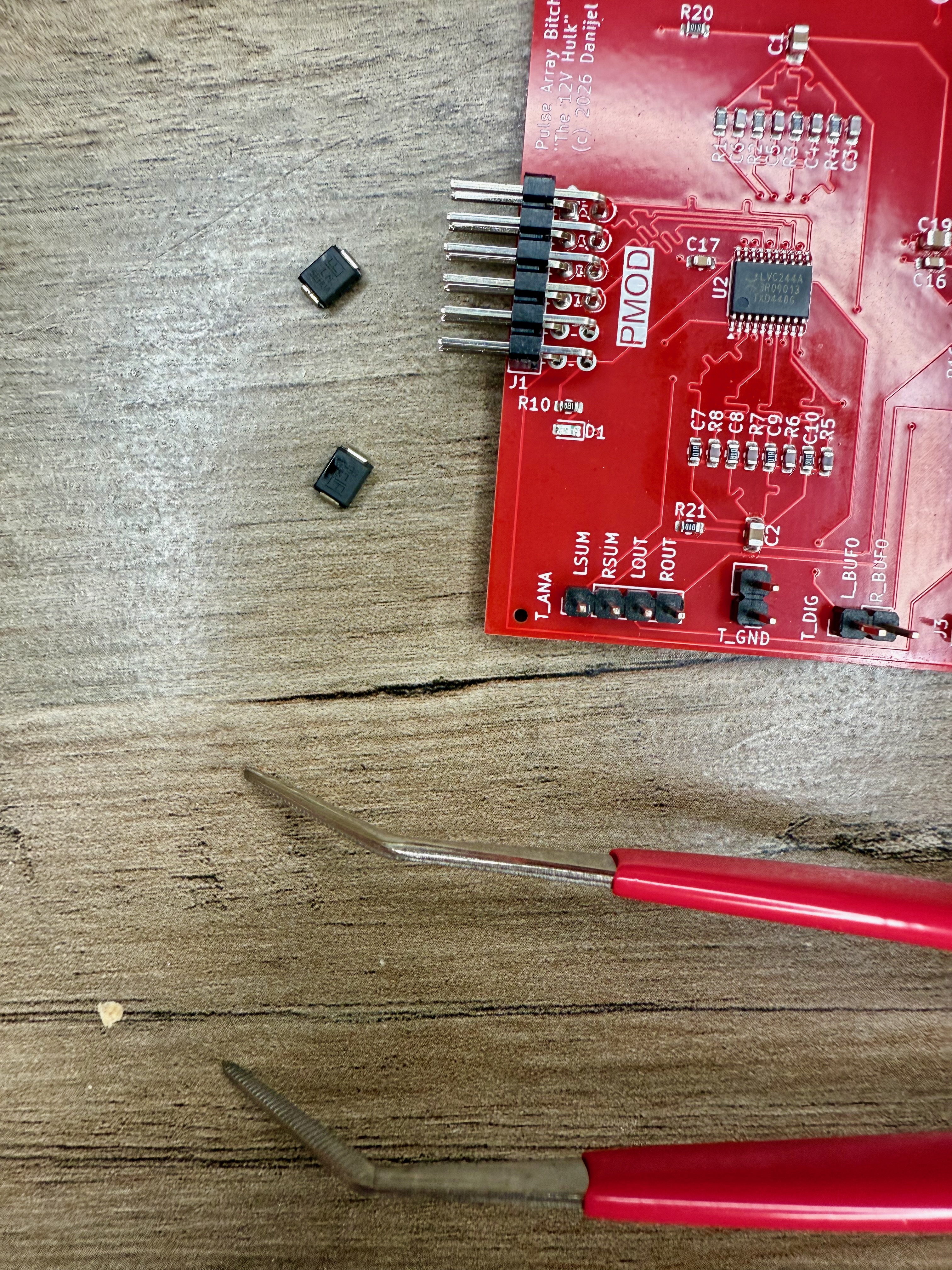
smd-rework-red-pcb.jpeg
Teaching myself SMD soldering to fix a JLCPCB assembly mistake. Tweezers, tiny components, and a rework station I bought specifically for this. The speedrun has no brakes.
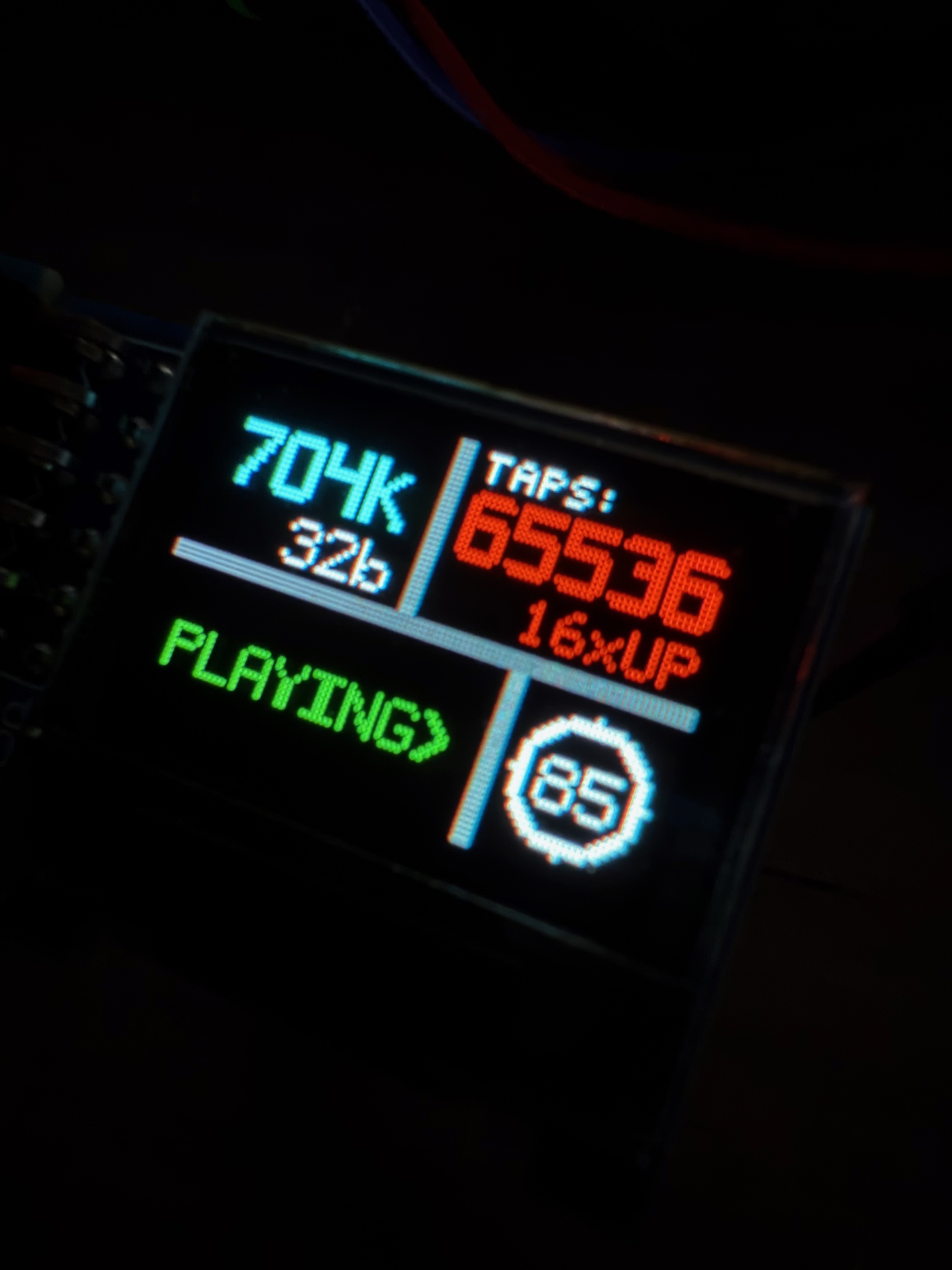
oled-display-playing.jpeg
The OLED display via Digilent PMOD. 704K sample rate, 32-bit, 65,536 taps, 16× upsampling, volume 85. Glowing in the dark like a proper piece of audio gear. Because aesthetics matter.
The Measurements
oscilloscope-sine-output.jpeg
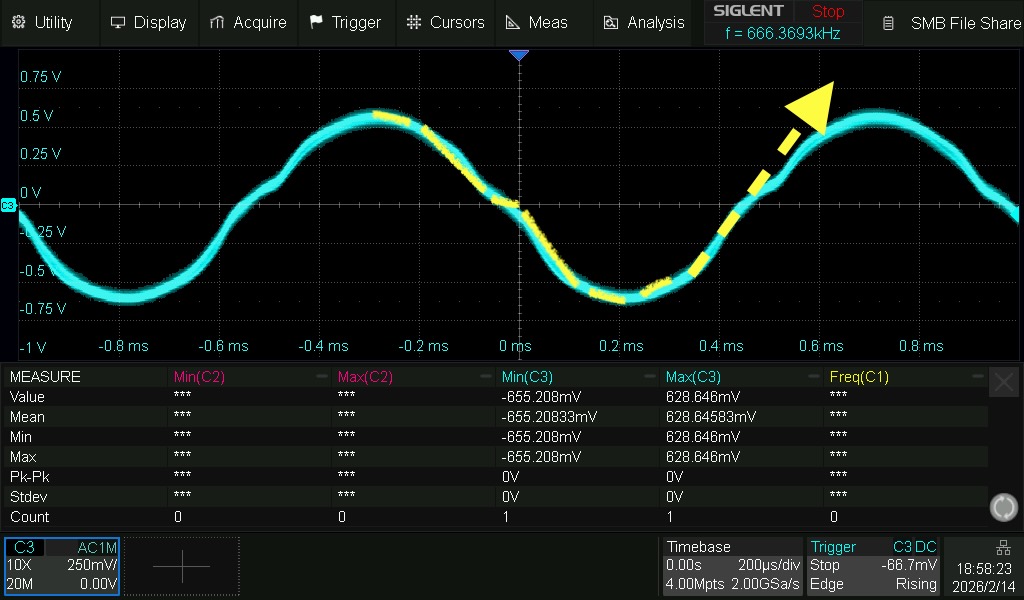
NOT clean. The yellow arrow shows where the sine SHOULD be. The cyan trace is what actually came out — destroyed by grainy voltage levels from a DDR OSERDES experiment where non-deterministic duty cycles on rising AND falling edges killed everything. This is what learning looks like. Feb 14, 2026.
pulse-array-fft-spectrum.png
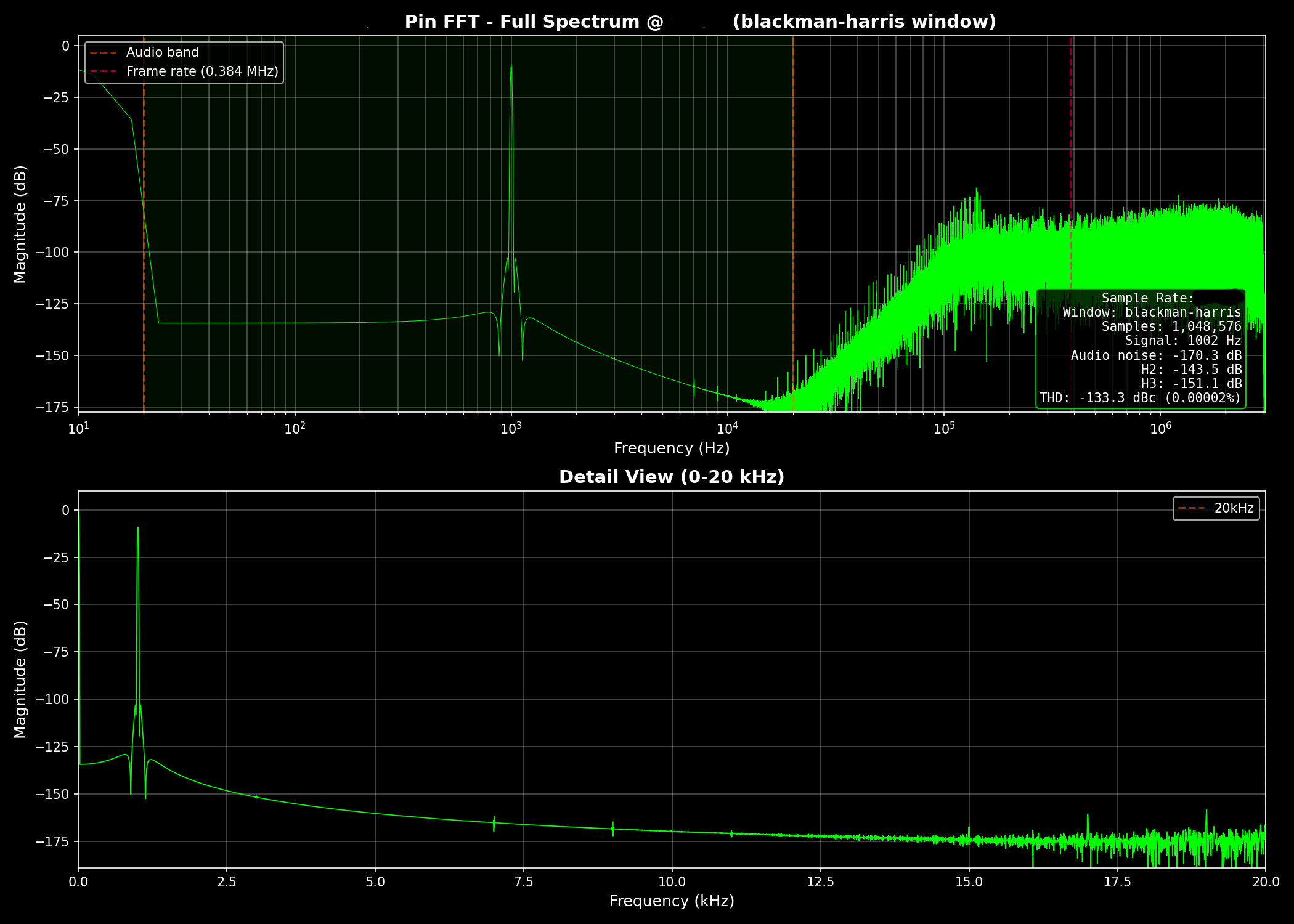
The money plot. Full spectrum: noise shaping pushes quantization noise above the audible band (that green wall). Detail view 0-20kHz: clean audio band. THD: -133.3 dBc. Audio noise: -170.5 dB.
rta-spectrum-analysis.png
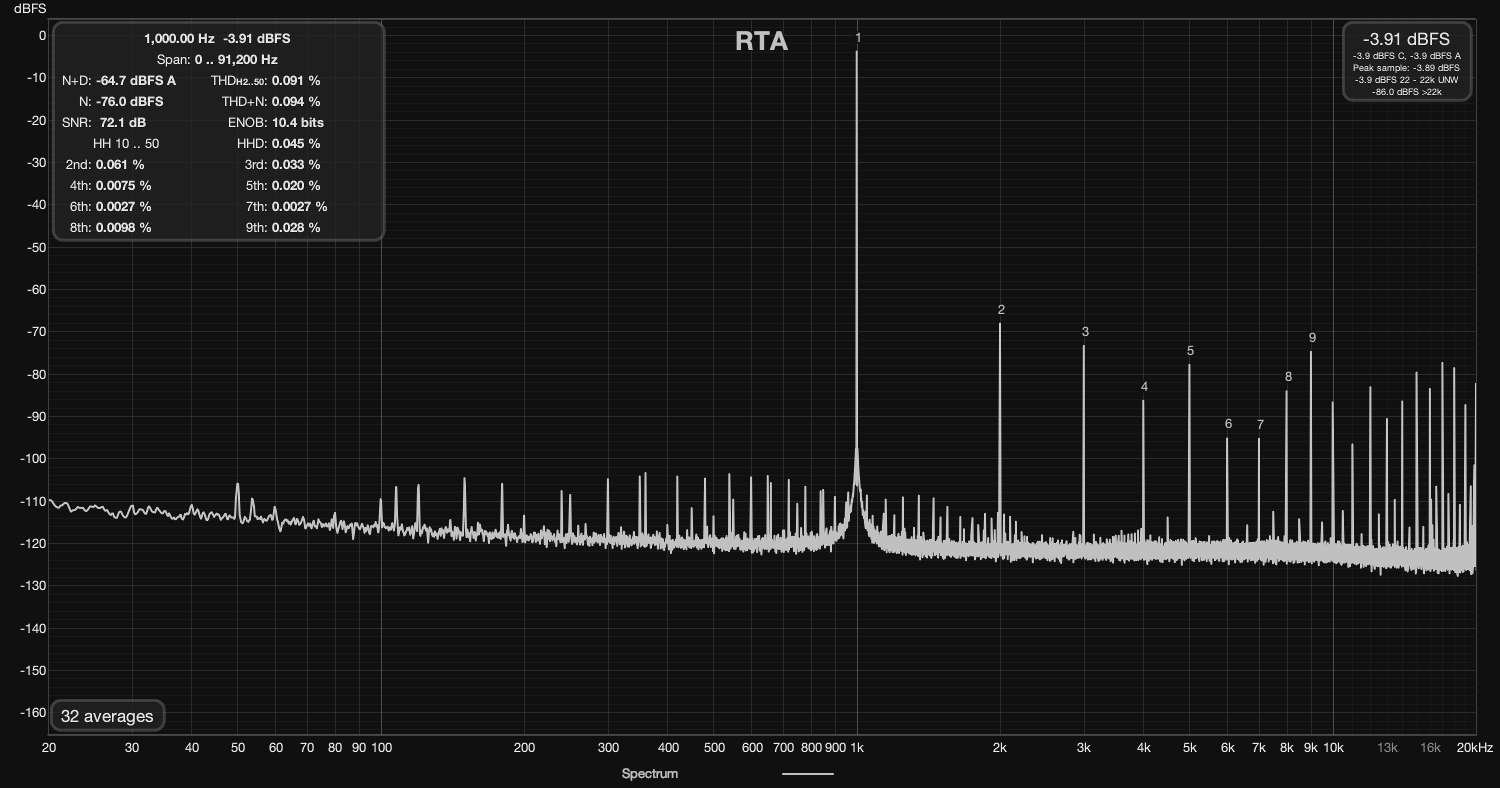
Real-time spectrum analysis of the analog output. 1kHz fundamental with harmonic structure visible. The measurements that will eventually speak louder than any marketing.
POSTLearnings · Afterthoughts · Timeline
learnings
What I learned:

  - You can teach yourself FPGA development from zero using AI as
    a tutor. The learning style of try → fail → ask → never forget,
    combined with Claude's patience, is absurdly effective.
    10 weeks from "what is Verilog" to a working 507k-tap DAC.

  - Rob Watts is right about tap counts. There IS a difference above
    16× oversampling. Whether it's transient precision, pre-ringing
    elimination, or something else — more taps means more real.

  - Timing violations are common during rapid iteration. This project
    ran with negative WNS for most of development. It worked on
    hardware, but proper timing closure is the goal for production.
    Dev speed and production rigor are different disciplines.

  - The hardest problems are at domain boundaries. Not inside the
    FIR, not inside the SDM — at the clock domain crossings. The
    CDC rate-limiting discovery was a 117dB fix. Boundaries matter.

  - Thermometer encoding is a trap. It looks obvious. It's wrong.
    Signal-dependent switching noise is real and audible. I spent
    months learning this. Phase-shifted multi-bit output or nothing.

  - Custom PCBs from China are magical. ~$50 for a 4-layer board
    with assembly and shipping. Delivered in 2 weeks. The
    democratisation of hardware is real.

  - MATLAB is not optional for DSP work. You MUST validate
    algorithms in simulation before translating to Verilog. The
    feedback cycle is too slow otherwise.

  - The audio community responds when you give them a product to
    believe in. The moment I announced "this is becoming a product,"
    engagement exploded. First beta tester within 5 minutes.
The connection to everything else: This project is the same thing as Friend, just in a different domain. Friend reconstructs authentic connection from data. The DAC reconstructs authentic sound from samples. Both are about removing layers of distortion between me and reality. Both are about building what I need because nobody's selling it at a price — or quality — that makes sense.
I've spent my life exploring what's real. If we're living in a simulation (and I half-believe we are), then signal reconstruction is literally how the universe renders experience. A DAC that perfectly reconstructs an analog waveform from digital samples is doing what reality does every time you hear a sound. Understanding that process — truly, at the silicon level — feels like peeking behind the curtain.
what's next
What's next:
  Path chosen: build a product. The BELLA DAC 1 by Pretty Good DACs.
  507,904 taps. Multi-bit resistor array output. Field-updatable.
  Not competing with Chord — I genuinely
  respect their products. This is about pushing the limits of
  what's physically possible and seeing how far the philosophy
  scales. prettygooddacs.com is live. Waitlist is open.
timeline · 177 commits in 72 days
Timeline (177 commits in 72 days):
  - 2025-12-15: First commit. "How hard can it be?" — famous last
    words from a man who'd never written a line of Verilog.
  - 2025-12-17: I2S deserialization working. Multi-rate detection.
    First WORKING code — tested with 44.1kHz and 96kHz audio.
    Two days from zero to receiving audio on an FPGA.
  - 2025-12 to 2026-01: FIR upsampler (64× initially). SDM
    prototypes (2nd, 3rd, 4th order — all archived). First analog
    output attempts on breadboard. Learning oscilloscopes.
    Learning what "negative slack" means (and that it's fine).
  - 2026-01: 64K-tap FIR validated against Python golden model.
    CDC input fixes. UART coefficient upload working.
    First time hearing upsampled audio through the FPGA.
    That moment. Sound coming out of something YOU built from
    nothing. From Verilog YOU wrote. Through analog stages YOU
    designed. That's the moment.
  - 2026-02-06: Rate limiting discovery. 117dB improvement.
    Integer CDC timing kills the 47kHz horns dead.
  - 2026-02-13: SDM v2 with 1-stage DSP48 feedback. 22dB better
    noise than the 3-stage version. Feedback latency matters.
  - 2026-02-15: Phase-shifted multi-bit output stage — my own algorithm.
    Inspired by Rob Watts' philosophy, implemented my own way.
  - 2026-02-16: Doubled to 128× FIR. 56 tiles × 128 phases.
    114,688 taps. Closing in on DAVE's ~164k.
  - 2026-02-20: HDMI 720p video output with real-time FFT spectrum.
    OLED display via Digilent PMOD. Because why not.
    A/B testing via hardware switch.
  - 2026-02-23: HDMI + DAVE regime analysis.
  - 2026-02: 256× FIR. 112 tiles × 256 phases. 229,376 taps.
    25×32-bit native multiply — 2 DSPs per tile instead of 4.
    Custom-designed sinc filter/window — the "GOAT filter."
    DAVE's ~164k taps: passed.
  - 2026-03: 507,904 taps via symmetric coefficient mode (2×).
    124 tiles × 256 phases × 2 = half a million taps. 3× DAVE.
    3-band parametric EQ in the FPGA (48-bit, 137dB SNR).
    Transitioning to Trenz A200T-2C module (12A VRM, better timing).
    prettygooddacs.com launched. Head-Fi thread restructured.
    Product announced. First beta tester within 5 minutes.
    r/diyaudio post. diyAudio forum engagement exploding.
    The project has a name: BELLA DAC 1 by Pretty Good DACs.

Current state:
  - PCB v0.4.4 incoming (externally clocked DFFs, 100MHz crystal)
  - 2×4 elements with phase-shifted PWM, scaling to 2×20
  - Trenz A200T-2C module on order (fixes brownout issues)
  - 3-band biquad EQ with user-saveable profiles
  - Head-Fi diary active, diyAudio thread active, Reddit posted
  - Waitlist open at prettygooddacs.com
  - First beta tester volunteer (Germany)
  - Next: validate DFF output stage, scale elements, ship prototypes
chordkiller.html·177 commits · 72 days · 507,904 taps