The premise
Human hearing stops at about 20 kHz. Cats hear up to about 64 kHz. Bats shout far above that. There is a whole layer of sound around us, all the time, and we are deaf to it.
The Predator from the movie sees heat. I wanted the audio version first: an extra sense. Walk around with headphones on and hear the part of the world that is normally silent.
Phase 1 is sound. Phase 2 is vision — an IR camera, one day.
The hardware stack
The normal Pi audio input stops at 48 kHz. Useless here. The Ultramic is a USB mic that records at 250,000 samples per second. It plugs in like any sound card. It knows exactly one mode: 16-bit, mono, 250 kHz.
How you fold sound
The trick is borrowed from radio. Take a slice of the ultrasonic band. Slide it down so it starts at 0 Hz. Now it sits in the audible range. This is called heterodyning — the same move every radio receiver makes.
Cheap analog bat detectors do this too. But they also fold a mirror image on top of the signal, so you hear two things at once. My version filters the slice first and then shifts it. No mirror image.
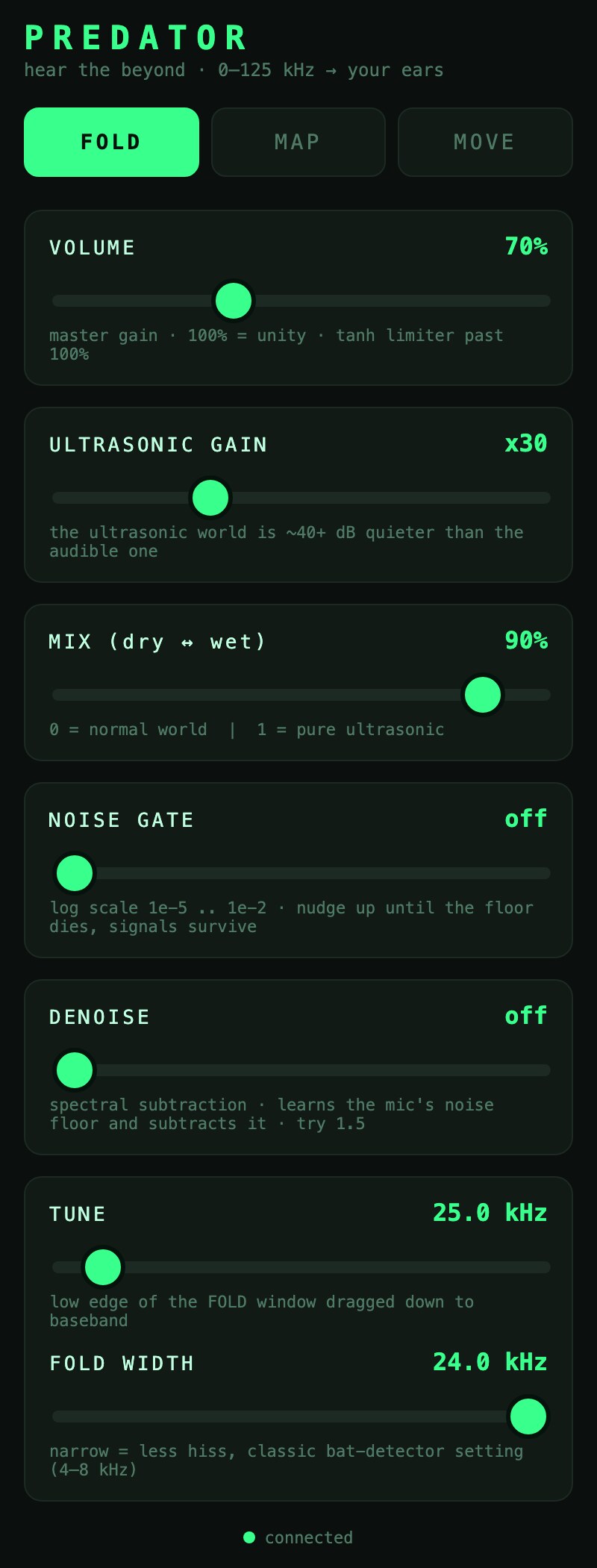
On top of that: a mix slider between normal hearing and the folded ultrasound. So you hear the room AND the hidden layer at the same time. Plus a noise gate and a denoiser. The ultrasonic world is about 40 dB quieter than the normal one. Boost it that much and the mic's own hiss gets loud. The denoiser learns the hiss and removes it. Short loud events — clicks, chirps — pass straight through.
Everything is processed in small blocks, live. The hard part is the block edges: every filter has to carry its state from one block to the next, or you hear a click 120 times a second. Every block-based piece is tested against processing the same audio in one go. 20 tests. They pass on the Mac and on the Pi.
What I heard
I took it out in Cyprus. Headphones on, Pi in the pocket, phone as the remote.
In the woods: weird alien noises. Clicking, everywhere, from things I could not see. At home: the electricity in the power sockets, suddenly audible. And somewhere, a strange repeating sound, like Morse code. Something was sending. I have no idea what.
Super cool. That is the entire review.