I've always been drawn to pattern recognition. When a neighbor introduced me to futures trading, the markets seemed like a natural fit. "This could be my thing," I thought.
A neighbor introduced me to SierraChart and futures trading. No compromises — SierraChart is the most capable platform I found, even if it's not beginner-friendly. I jumped straight into the deep end: Gold, Oil, Nasdaq (NQ), S&P 500 (ES), and the German DAX (FDAX).
I quickly identified my own weakness: I was too emotional. Every trade became personal. So I asked myself: what if I remove the emotional edge by letting a system execute my orders following strict rules? Best of both worlds — my pattern recognition, the computer's discipline.
That's when I started coding custom studies in ACSIL (SierraChart's C++ interface). I love coding and learning new languages, and here I could bridge both worlds — trading and programming, while building tools that actually helped myself.
All trading concepts are my own observations. I let myself be inspired by ideas floating around — supply/demand zones, delta analysis, order flow — but nothing counted until I saw it myself, validated it myself.
zone trading suite · execution · range trading
Zone Trading Suite:
  - ZoneMaster: Draws and manages supply/demand zones
  - BracketMaster: Auto-detects consolidation zones
  - DanTheDumbTrader: Zone-based discretionary UI
  - ZoneDeltaReversalTrader: Delta reversals within zones

Execution & Risk:
  - BracketBot: Automated order execution
  - ScalpMaster: OCO brackets + break-even management
  - StopLock: Forces you to commit to your stop loss
  - ATRtoRisk: Position sizing based on volatility

Range Trading (2025):
  - RangeDetector: Detects ranges, auto-trades boundaries
  - SC_Range_Bounce_Auto: Python backtest replica in C++
  - EUSupportBounce: EU session support bounces
The Topstep Cycle
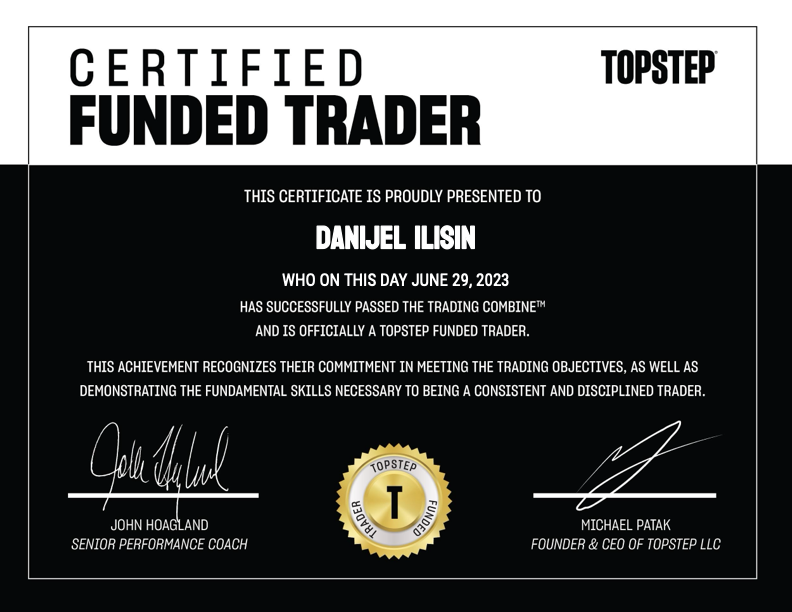
Topstep is a funded trader program — pass their evaluation, trade their capital, keep a share of profits. Simple concept. Brutal execution.
I passed. Multiple times. Then blew it. Rinse and repeat.
441 Topstep emails over two years tell the story without words. That's either commitment or insanity. In trading, they're the same thing.
The 2025 Evolution
I started using AI to dig through backtest data quickly. The range bounce strategy wasn't invented — it was something I noticed during discretionary trading. AI helped me validate whether the pattern was real or just confirmation bias.
Turns out the AI was hallucinating results — assuming ideal entries and exits without understanding real market constraints like slippage from low volume and order latency. The backtests looked beautiful. Live trading blew up. Another lesson learned the expensive way.
POSTLearnings · Afterthoughts · Timeline
learnings
Learnings:
  - The market doesn't care about your analysis. It only cares
    about other people's orders.
  - Emotional discipline cannot be willed into existence. Either
    systematize it or accept that you'll keep breaking your rules.
  - Robustness beats backtested Sharpe ratio every time. Live
    trading friction kills beautiful models.
  - Passing an evaluation means nothing. Keeping the account is
    the actual test.
  - Every "trading coach" I encountered was selling hope, not
    edge. The only edge is the one you find yourself.
  - Code doesn't lie. If your system doesn't work in backtest,
    it won't work live. If it works in backtest but not live,
    your backtest is wrong.
timeline
Timeline:
  - 2023-03: Started SierraChart (neighbor introduction)
  - 2023-04: First Topstep evaluation
  - 2023-05: Passed Step 2
  - 2023-06: First full pass, then blown
  - 2023-08: Passed again
  - 2023-09: Passed again
  - 2024-06: Still passing, still blowing
  - 2025-01: AI-assisted backtesting, range strategies
  - 2026-03: Open sourced the studies

Status: The code is public. The studies work. The emotional
  discipline remains a work in progress.
GALLERY
topstep-certificate.png
Topstep Funded Trader Certificate — June 29, 2023. One of many passes.