Late 2001. The Xbox launched in North America. I imported one from Canada to Germany before the European release because waiting was not an option. Plugged it into a projector. Played HALO all night. It was glorious.
Then I got curious about what was inside.
I got access to Microsoft's official Xbox Development Kit — the XDK. And those early revisions? Microsoft had shipped PDB debug symbols with their development kernels. The kernels themselves were basically x86 executables. Which meant you could load them into IDA Pro and read them like a book.
So I did.
I was 26 years old, armed with a disassembler, and I started pulling apart Microsoft's security architecture thread by thread.
The Group
There were maybe five of us. Distributed worldwide. Communicating through encrypted IRC channels. Each approaching the Xbox security scheme from a different angle. Hardware probing, software reversing, firmware analysis.
My angle was the software. The debug kernels. The XDK. IDA Pro running for days while I traced execution paths through Microsoft's protection layers.
This was never about piracy. It was about the puzzle. Microsoft had built what they believed was an unbreakable security system for a consumer device. We wanted to know if that was true.
The Discovery
Deep in the disassembly of the development kernels, I found it: the retail Xbox kernel was encrypted with RC4 — a symmetric stream cipher using a 128-bit key. The debug kernels referenced the mechanism, but the actual decryption key wasn't in the software. It had to come from somewhere on the hardware — a hidden EEPROM that the bootloader read on startup.
RC4 with a 128-bit key. Symmetric encryption. That meant one key to encrypt, the same key to decrypt. Find the key, and the entire retail kernel opens up. Every game disc verification routine, every security check, every protection mechanism — all readable.
One of the people in our group was Andrew "Bunnie" Huang, an MIT researcher who was approaching the Xbox from the hardware side. I told him what I'd found in the software: look for a 128-bit RC4 key, sitting in some hidden EEPROM on the motherboard. Try to RC4-decrypt the retail kernel binary with whatever you find. Once it decrypts cleanly, you've got the right key.
Bunnie went after it from the hardware side. He tapped the HyperTransport bus between the Southbridge and the CPU. He found the secret boot code. He found the key. He decrypted the retail kernel.
As he described in his book and his MIT paper: the RC4 key was stored at a specific address inside the hidden MCPX boot ROM, and it traversed the bus in the clear on every boot. Once captured, the entire security scheme unraveled.
That discovery triggered a cascade.
The Cascade
The 16-byte key was shared in an IRC channel. We asked for it to be deleted immediately. It was too late. Multiple groups had already seen it. Within weeks, the first generation of modchips appeared on the market. The Xbox security scheme was broken.
Once the retail kernel could be decrypted, everything became possible. Custom firmware. Homebrew software. Media center applications. And yes — piracy. The same key that enabled legitimate tinkering also enabled illegitimate copying. That's the dual-use nature of any security research, and it's a tension that never resolves cleanly.
The Builder
After the initial breakthrough, I went deeper. As the community's understanding of the Xbox kernel grew, I rebuilt the C++ build chain and got it working. From there, I could compile custom kernels and extend them with new features.
I built custom BIOS software for the Xbox homebrew scene. System menus, configuration tools, hardware diagnostics, video mode utilities, quality-of-life features for the growing community of people running modified consoles. Navigate menus with the controller, launch applications from the hard drive, customize boot animations.
A full custom operating environment for a game console. I was 27, writing operating system code and shipping it to a global community.
Some of that code is still running today. The Xbox retro scene on YouTube features setups booting into BIOS software I wrote over two decades ago. The green menu screens, the configuration options, the quick-launch features — that's my work, still alive in a subculture I haven't been part of in twenty years.
The Fear
Then Microsoft started hunting.
People in the scene were arrested. People I knew. The legal hammer came down hard on anyone connected to circumvention devices. The DMCA in the US, equivalent laws in Europe — this wasn't theoretical liability. People went to prison.
I was terrified. I was a young programmer in Germany who had spent months deep inside Microsoft's proprietary security architecture. The paranoia was constant. Every unexpected knock on the door. Every unfamiliar car parked outside.
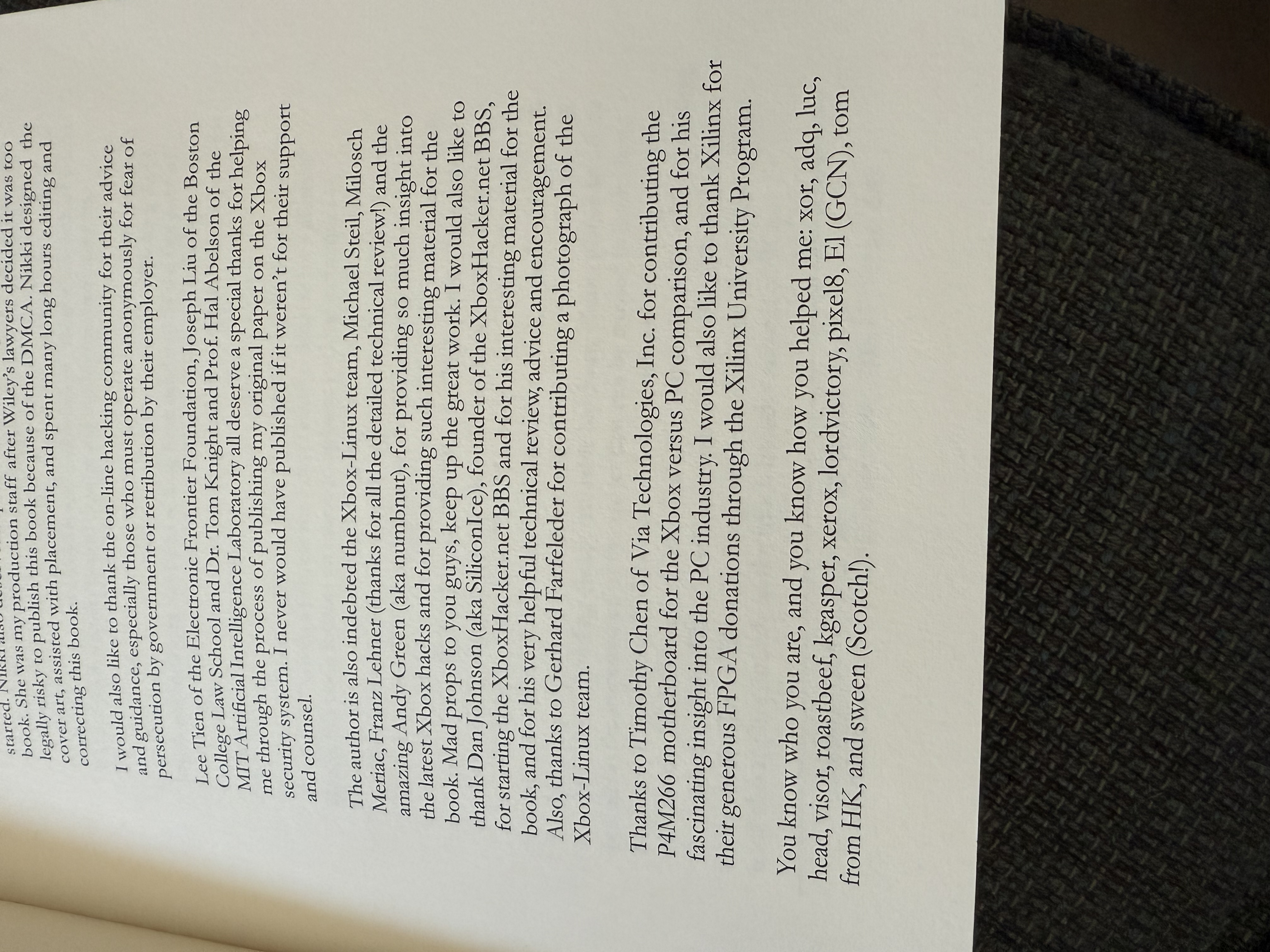
I had been operating under a handle — "headache" — and I had been careful about separation between my real identity and my scene identity. But careful isn't the same as safe. I even asked Bunnie to obfuscate my handle in the book — "head" instead of "headache." Every layer of distance felt necessary.
Eventually, I stepped back. The scene moved on. New Xbox revisions came out with updated security. The original Xbox faded from the spotlight, and with it, so did I.
The original Xbox has been off the market for two decades. The legal landscape for that era of console security research has since been extensively documented, litigated, and closed.
The Ironic End
All my tools, scripts, custom builds, IDA Pro databases, kernel modifications, build chain configurations — everything I'd created over two years of intense work — lived on a single hard drive encrypted with TrueCrypt full-disk encryption.
One day I accidentally erased the boot sector.
Everything. Gone. In a second. The guy who broke Microsoft's encryption destroyed his own life's work with his own encryption. No backup. No recovery. Just silence.
The only proof that any of it existed is a credit in a book.
What happened:
I helped crack the security of a major consumer electronics device at 26. I discovered the cryptographic architecture that protected it. I pointed a hardware researcher toward the physical location of the decryption key. I built custom operating system software that ran on millions of modified consoles worldwide. And then I lost all evidence of it to my own encryption.
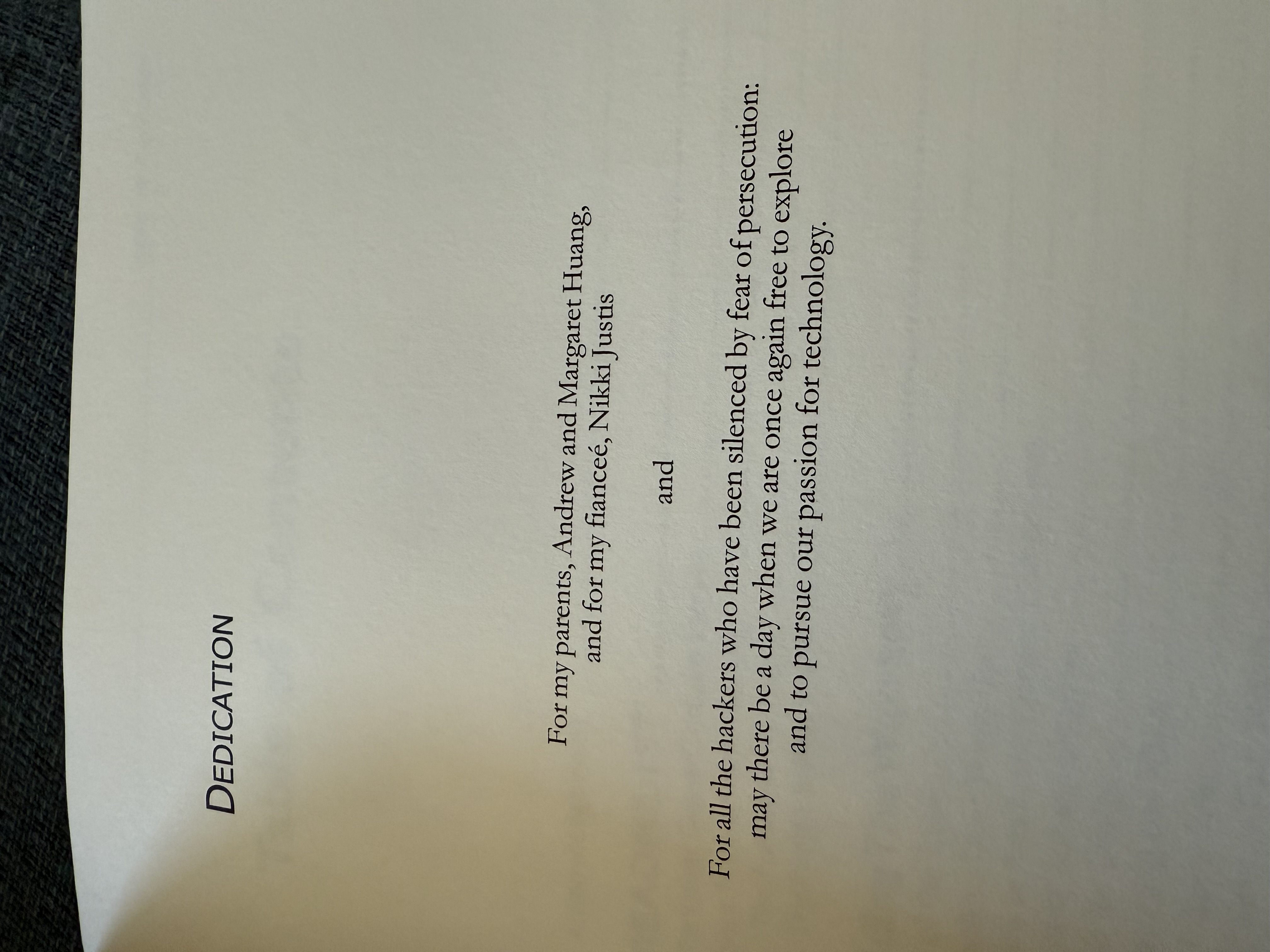
The book: Andrew "Bunnie" Huang published "Hacking the Xbox: An Introduction to Reverse Engineering" in 2003, supported by the Electronic Frontier Foundation. It documents the technical process of breaking the Xbox security scheme and became a foundational text in hardware security research. I am credited under my handle "head" in the acknowledgments.
Bunnie went on to become one of the most respected hardware hackers in the world. His work on open hardware, including the Novena open-source laptop and the NeTV video adapter, built on the same principles we explored together on the Xbox: if you own the hardware, you should be allowed to understand it.